How an AI video ad is made: from brief to final cut
Generation is one step out of ten. Here is the full path of one ad, the timing of every step and what we need from you.
 Magnet Minds
4 November 2026
9 min read
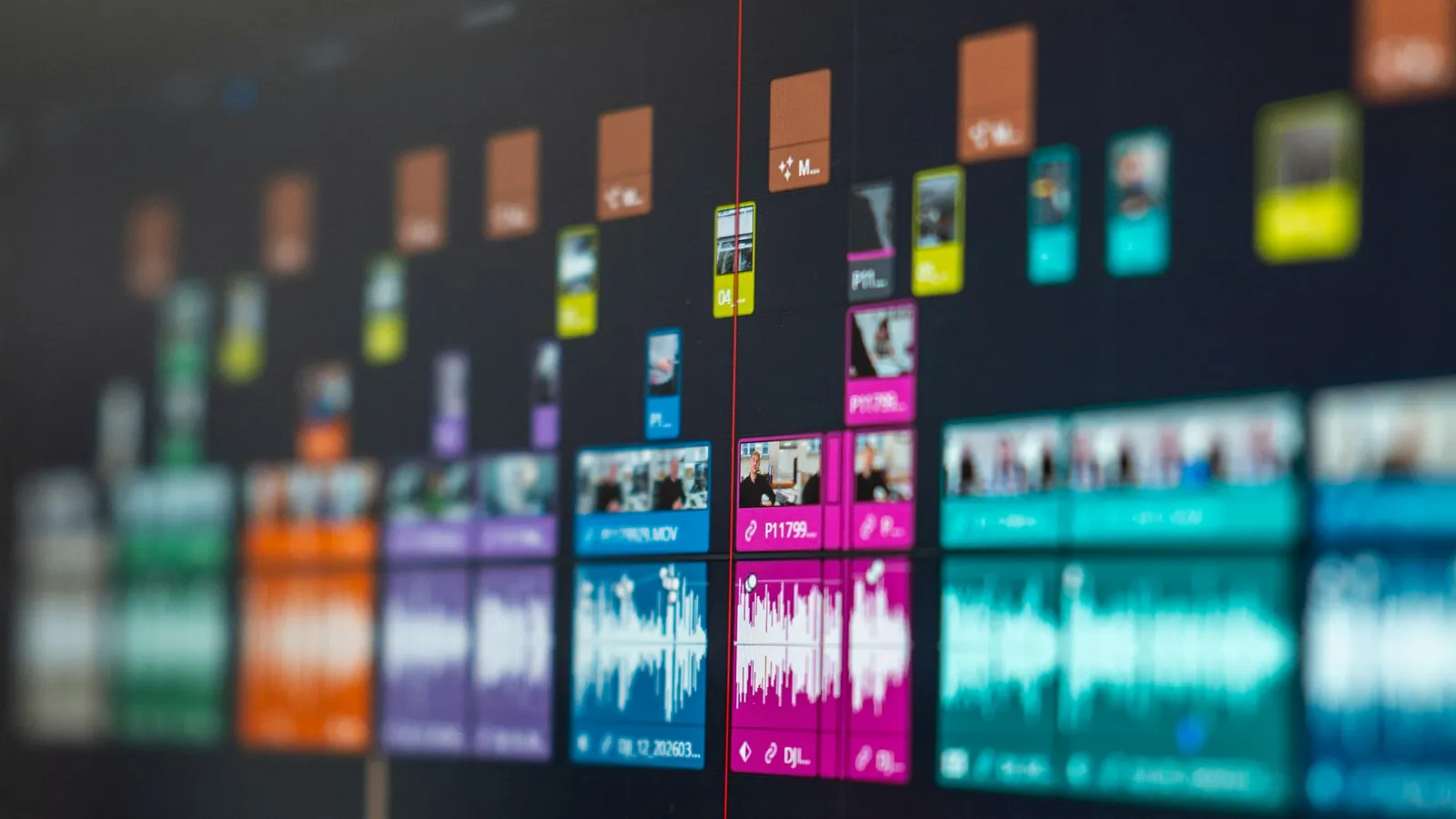 Photo: Andri Aeschlimann, Unsplash, Unsplash License
An AI video ad goes through 10 steps: brief, concept, script, key frames, generation, edit, sound, captions, formats and quality control, plus revisions. With us, scripts and key frames arrive within 3 working days of the brief, and the first finished videos within 7 working days of approving the scripts. Your part is one call and a few sign-offs.
- Generation is 1 step out of 10. Most of the time goes into the idea, the script, the edit and the sound.
- The approval that matters most is the key frames: you see what the ad will look like before any video exists.
- Every shot is generated several times and only the best take is kept.
- The finished ad ships in 9:16, 1:1, 4:5 and 16:9, with sound and captions, checked against the areas Meta and TikTok cover with buttons.
- The two revision rounds are for details. A new idea means a new brief.
What are the steps and how long does each take?
The process has two phases. In the first, everything lives on paper and in still frames, so changes are quick and cheap. In the second, we generate, edit and add sound, and every change costs more.
| Step | What happens | What you do | When |
|---|---|---|---|
| 1. Brief | Goal, product, offer, platforms, deadline | Send a brief or your website link, 30-minute call | Day 1 |
| 2. Concept | 2-3 ideas with the opening seconds and the message | Pick a direction or let your team vote | Within 3 working days of the brief |
| 3. Script | Second-by-second: what we see, hear and read on screen | Read and comment | Within 3 working days of the brief |
| 4. Key frames | Still images of the main shots | Approve the look (up to 2 rounds) | Within 3 working days of the brief |
| 5. Generation | Video from the approved frames, several takes each | Nothing | Within 7 working days of approval |
| 6-7. Edit and sound | Rhythm, colour, voice, music, effects | Nothing | Within 7 working days of approval |
| 8-9. Captions and formats | Subtitles, 4 aspect ratios, safe zones | Nothing | Within 7 working days of approval |
| 10. QC | Shot-by-shot checklist | Nothing | Before delivery |
| Revisions | Up to 2 rounds per video | One consolidated round of feedback | After delivery |
The clock stops while we wait for your feedback or materials. The fastest projects are the ones where one person approves and replies the same day.
Step 1: what should the brief contain?
A good brief answers six questions: what the ad should achieve, who it speaks to, what the offer is, which product details must be shown, where it will run and by when. If you have no time to write one, a website link and a 30-minute call do the same job. A full copy-ready template is in our guide on how to brief an AI video.
Steps 2 and 3: how do you get from idea to script?
The concept settles two things: what the ad says and why anyone stays past the first second. The second matters more than it looks. A 2016 Facebook and Nielsen study found that up to 47% of a video campaign's value is delivered in the first 3 seconds, and up to 74% in the first 10.
The script is a second-by-second table. For every shot it says what we see, what we hear and what text is on screen. Each video also gets several different openings, so your ads can test which one stops the scroll. Read the script as if it were the finished ad: if a line does not sound like your brand, now is the time to say so.
Step 4: why are key frames the most important approval?
Key frames are still images of the ad's main moments: the character, the product, the place, the light. The video starts from them, so the decisions made here last to the end.
- The product. Label, colour and shape are checked letter by letter. A mistake in the frame becomes a mistake in every generation after it.
- The character. If the same person appears in shot 2 and shot 5, they need the same face, hair and clothes. That gets locked in the frames.
- The style. Palette, light, lens. Decided once, they make 10 shots look like one film.
Changing a still takes minutes. Changing a generated video means a new generation, a new edit and new sound. That is why our guarantee sits on exactly this step: if you do not approve the scripts and frames after 2 rounds of changes, we refund the advance.
Step 5: how is the video generated with today's models?
Every shot is generated from its approved image (image-to-video), several times, and the best take is kept. We work with several models and pick the one that handles each shot best:
- Seedance 2.5 (ByteDance, released 31 July 2026): up to 30 seconds per generation and up to 30 images, 10 videos and 10 audio clips as references. In our work we use it for camera moves and dialogue scenes.
- Veo 3.1 (Google, announced 15 October 2025): generates picture and sound together and can bridge a start frame and an end frame.
- Kling: we use it for short shots without dialogue.
Models change every few months. The craft rules stay: short shots of 4 to 6 seconds, one action per shot, real sound on top. We cover exactly how to get video that does not look like AI in a separate guide: how to make AI video that doesn't look like AI.
Steps 6 and 7: what happens in the edit and the sound pass?
The edit sets the rhythm: where each shot cuts, which shot follows, and what the last one leaves you with. Then a single colour pass makes separate generations look as if they came from one camera.
Sound has three layers. The voice is an AI voice in your language or a recording of your own speaker. The music comes from libraries licensed for advertising, so Meta or TikTok will not mute the video. The effects are real recorded sounds placed on the exact frame: a footstep, a box opening, a click. Finally we level the loudness so the ad does not jump out against the videos around it in the feed.
Steps 8 and 9: which captions and formats do you need?
Meta lists captions for Reels ads as optional but recommended, and sound as strongly recommended. So every video ships with both: captions burned into the picture and a separate SRT file.
Formats are cut from the same scene, each framed on its own, so the product never ends up behind the buttons. Meta advises leaving at least 14% at the top, 35% at the bottom and 6% on each side of a vertical Reels frame free of key elements.
| Format | Where it runs | What we watch |
|---|---|---|
| 9:16 | Reels, Stories, TikTok, Shorts | Text and product clear of the top 14% and bottom 35% |
| 4:5 | Instagram and Facebook feed | Product centred, faces never cropped |
| 1:1 | Feed, catalogue ads | Text still readable on a small screen |
| 16:9 | YouTube, website, TV | Reframed separately, wide shots never stretched |
Step 10: what do we check before sending you the video?
Every video goes through the same list, shot by shot:
- Hands and fingers: count, shape, how they hold the product.
- Labels, logos and text on the product: letter by letter.
- Faces: the same person across every shot.
- Lips and voice: in sync, with correct stress in the spoken language.
- Captions: spelling, timing, nothing inside the button zones.
- Sound: no clicks, no sudden jumps in loudness.
- AI label: whether the scene could pass as real.
The last point is a legal requirement. Since 2 August 2026, Article 50 of the EU AI Act requires the advertiser to disclose generated content that could pass as authentic. Which videos need a label and how to add it in Meta and TikTok is covered in our article on the rules for advertising with AI.
How do revisions work, and when is it a new order?
Every video has 2 revision rounds. They cover details within the approved script. If the direction changes, that is a new brief, because the work restarts at step 2.
| Revision | New brief |
|---|---|
| Shorter opening shot, different on-screen text | A different idea or character |
| Different music or voice | A different product or offer |
| Brighter grade, different shot order | A new platform that needs a different story |
The most useful feedback has three parts: the timestamp, what is wrong and why. "0:04, the logo is too small, you can't read it on a phone" gets fixed fast. "Something feels off" leads to another round.
The most common cause of delay is feedback from five people who contradict each other. Collect the comments in one place and send one combined answer. We give you a link with the concepts where your team can vote and comment for exactly this reason.
Questions
With a clear brief, scripts and key frames are ready within 3 working days, and the first videos within 7 working days of approving the scripts. A traditional production with a shoot day usually takes 4 to 6 weeks. Late approvals are the biggest time sink, because the clock stops while we wait for an answer.
Yes. Key frames are still images of the main moments: character, product, location and light. You approve them together with the script before any video is generated. Changes are quickest at this stage, which is why it comes with 2 revision rounds and a refund guarantee on the advance.
You get the video in 9:16, 1:1, 4:5 and 16:9, with music and sound effects, captions burned into the picture and a separate SRT file. Each format is framed on its own, so the product and the text never sit under Meta's or TikTok's buttons.
It depends on the scene. Since 2 August 2026, Article 50 of the EU AI Act requires you to disclose generated content that could pass as real, such as a generated person who looks like a real customer. Clearly unreal scenes usually need no label. We decide this at the concept stage.
A revision changes a detail inside the approved script: on-screen text, music, voice, colour, shot order. A new order is a change of idea, character, product or offer, because the work restarts from the concept. Every video includes 2 revision rounds.
Got a brief? We start there.
Send a brief or your website link. Within 3 working days you see the scripts and key frames, and the first videos arrive within 7 working days of your approval. If we are late, the late videos are on us.
See the offers- Facebook (Meta) and Nielsen: video campaign value in the first seconds, 2016
- Meta Ads Guide: Instagram Reels ad specifications
- TikTok Ads: video ad specifications
- TechNode: ByteDance launches Seedance 2.5, 31 July 2026
- Google: Introducing Veo 3.1 and advanced capabilities in Flow, 15 October 2025
- Regulation (EU) 2024/1689, Article 50: transparency obligations